Monday, April 29, 2013

pHive Having pHun!


By Roberta Andresen
Photos by Deb Rychert

If you ever want to have a good time, be sure to get involved in a project with CQA member Deb Rychert.  Deb heard about the possibility for an outdoor sculpture at CQA's upcoming "Salsa!" exhibit at Mighty Tieton, near Yakima WA, and asked if some of us were interested.  The resounding answer was, “Yes.”  Deb, Barbara O’Steen, Sonia Grasvik, Carla Stehr and I met at Deb’s house.  We wanted to make a sculpture that could wrap around one or more of the trees outside the gallery.

Our initial supplies included recycled produce bags, yards of  nylon, a heavy mesh, and an exhibit catalog on textile sculptures. We started by looking at the catalog and picking out some favorites.  As we looked at the materials we thought we could use the heavy mesh as our support, and sew long narrow pointed tubes from the nylon that could be tied to the mesh.  The other materials were talking to us--we just didn’t know quite what they were saying.  A delightful lunch and lots of good conversation sent us on our way to do more thinking and gathering of supplies.    

A few days later we reconvened. The nylon tubes were tied on as were some of the produce bags that had been rolled into doughnut shapes.  It was starting to take shape.  Time for another break and then we got together again.  Now we had added surveying "whiskers," colored plastic cups that had been cut and heated to flare into flower-like forms, and bright pipe cleaners. Twist ties anchored our forms to the mesh and it became fuller and fuller.


Sonia mentioned that she crocheted around rocks and was immediately put into action.  Some rocks from a neighbor and fluorescent nylon cord were all she needed.  The finishing touch was being created.

As we worked we frequently took our creation outside, wrapped it around a tree in Deb’s yard, and critiqued our growing masterpiece.  Some tulips got trampled in the process, but what fun we were having!

Now for a name...With all our interest in recycling, the sea-form look, and Carla’s interest in the ocean, we thought about how the pH of waters are changing and the fun we'd had creating together.  And so we came to the idea of using words that started with “F” but substituting “pH”  for the “F” in words.  Our final selection was pH-antabulous, pH-ibrous pH-lotsam.  We just had pHun and did not take ourselves too seriously.  We hope that viewers, whether in Yakima or on Deb’s street, have as much pHun  looking at it as we did creating.  
********
CQA's "Salsa!" exhibit, comprising more than 30 art quilts, six pieces of decorated "art cloth" and five 3D pieces, will run from May 25 through July 14 at the Gallery at Mighty Tieton, with an opening artists' reception from 12-5 on May 25. Part of the exhibit, "Salsa in the Sun," will present various artworks placed outdoors around the town. Tieton is a small agricultural-based town near Yakima, WA, the heart of which--"Mighty Tieton"--has been converted into an incubator for artisan businesses. The gallery space is a huge, refurbished former fruit warehouse. (For more information on the venue, driving directions, etc., go to http://www.mightytieton.com)


Tuesday, April 16, 2013

Joy Rome shows the joys of color!


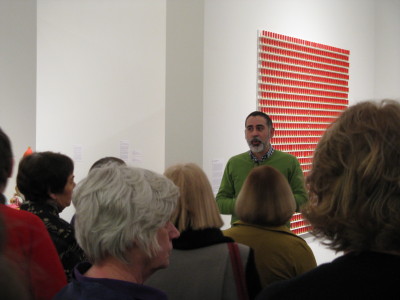
Many of us hope to achieve a balance in our lives between time spent dealing with the necessities and time for expressing our creativity. Seattle-area painter Joy Rome, speaker at the CQA April 2013 meeting, has successfully managed to do just that. For three days a week she maintains her busy psychotherapy practice. Then on the other four days, she paints—and the colors flow from her brushes with an evident elation that matches her name.

Painter Joy  Rome at CQA's April 13 meeting
Originally from New York, Rome worked in advertising on the East Coast before moving to the West Coast and movie-business assignments in California. She had some experience working with fiber early on, as her first commissioned piece was a “clamshell” design art quilt for a therapist’s office in Los Angeles. But it was a weaving course at San Diego State that set her on her path as a colorist. The weaving instructor took Rome on as an apprentice tasked with dressing looms and mixing dyes, which provided her a bone-deep knowledge of pigments and colors.

Rome soon struck out on her own and created weavings—“fiber constructs”—for residences and large hotels, etc. She would show potential designs to clients in the form of “maquettes,” or small versions of the works where she blended colored pencils to represent the subtlety of color achievable through the use of multiple threads per bobbin that is the hallmark of her Aubusson-tapestry style weavings. Some of her pieces contained bits of her own Japanese-style handmade paper.
"Maquettes"--small pieces done in colored pencils-- Rome produced for tapestry clients' approval before creating large "fiber constructs."

Life changes resulted in Rome selling her looms and leaving California for Seattle, and a hiatus in her creative pursuits as she returned to school for training in psychotherapy. But soon the love of color and fabrics once again took hold and she started making quilts, this time dyeing and painting her own materials to achieve desired colors. Rome says that mixing dyes for the weaving yarns was all formula-based, but she found painting was so liberating in its color creation: “Color is my vehicle into what I want to talk about,” she says.

Many of her art quilts are collages, combining fabrics, her handmade papers, often some found objects and painted surfaces, and are framed. Some are all fabric, but entirely painted. Frequently she incorporates a female figure in these pieces, sometimes via the basic elements of the piece, sometimes in the quilting stitches.

CQA member Marcia Mellinger holding one of Rome's framed collages
Closeup of a Rome piece with female nude as part of quilting lines

A Rome art quilt done in paint on fabric

Small, unfinished quilted piece by Rome, with seated nude (in stitching) at right

Rome returns to her tapestry weaving roots in this collaged piece

Rome’s more recent works are abstract paintings in fairly large sizes (36”x48” is typical) and brilliant in color. “The fun of abstract art is that it invites the viewer to participate in the painting,” says Rome. “It asks you to not just be a passive viewer…turn it in different directions and the impression changes for each viewer.” She adds that “Abstract artists frequently have trouble finding places to exhibit because the pieces are usually large and do ask you to stop and spend time with them.”

“Painter’s block” is something that hits even such an experienced artist, and when it does, Rome will take out a big piece of paper or canvas and “just make a mess!” Sometimes she’ll take a stack of small pieces of canvas or paper and quickly create some color patches or visualizations of thoughts, just to get her hands moving and stop intellectualizing. She keeps an “inspirations folder” like most creative folk, and advises others to “review your memory banks of places you’ve been when you’re looking for a stimulus…you don’t even need a photo.”

Rome considers this large canvas "a total mess," made just to get the creative juices flowing
Rome cites some of her own inspirations and influences as the works of Mark Rothko and Georgia O’Keefe, as well as Helen Frankenthaler and Kenneth Noland of the “color-field painters” who worked with untreated canvas in order to have the colors bleed into the fibers.

For more of Rome's work, see her website, http://www.joyromeart.com.


Wednesday, March 20, 2013

Brazil’s “Patchwork Design” show


Brazil’s “Patchwork Design” show

Over the past several years, a number of CQA artists have been invited as individuals to participate in the annual "Patchwork Design" show that starts in Sao Paulo, Brazil and then travels to Rio de Janeiro. Visitors at the shows voted for their favorites among the CQA pieces, and the 2-3 artists whose pieces received the most votes were invited to attend the subsequent year’s events as guests of the show organizers.

The lucky winners from the 2012 event were Sonia Grasvik, who this year traveled to the Sao Paulo show (March 14-16, 2013), and Helen Remick and Marianne Burr, who will attend the Rio show (April 25-27, 2013).
"Tango" by Marianne Burr

"Birdsong 1--Yearning" by Sonia Grasvik


"Spinning Out, Spinning In--4" by Helen Remick
In advance of the 2013 show, CQA was invited to participate as a group so that entry was open to all members. A panel within CQA nominated the entries to be submitted to the show organizers, who juried the submissions and made the final selection of artists and quilts for this international show.

Three pieces were selected from each exhibiting artist, including new work from Grasvik, Remick and Burr. Other CQA members included in the 2013 show are: Colleen Wise, Mary Arnold, Jill Scholtens, Bonnie Bucknam, Debi Harney, Melisse Laing, Lynne Rigby, Louise Harris, Marylee Drake, Patti Bleifuss, Cathy Erickson, Ruth Vincent, Donna Hudson and Bonnie Brewer.

"Bamboo" by Patti Bleifuss


"Gearing Up for the Future" by Marylee Drake


"Innovate, Inaugurate, Initiate #3" by Donna Hudson


"Firewall" by Jill Scholtens


"Steps" by Cathy Erickson


"Snowy Night" by Ruth Vincent

For views of all 51 works in the show by these and other CQA artists, please see the CQA website. or check out the Rutesato show itself! 


Friday, March 15, 2013

Yes...metal mesh can be a fiber!


Award-winning, Anacortes-based artist Lanny Bergner can work sculptural magic with a roll of aluminum insect screening or stainless steel mesh, a pair of flat-nosed pliers, a small torch—and a whole lot of patience!

At the Contemporary QuiltArt Association’s March 9 meeting, Bergner described his artistic journey from his degrees in sculpture (BFA, University of Washington; MFA, Tyler School of Art, Temple University, Philadelphia, PA.) to being possibly the country’s largest individual purchaser of industrial screening.

Bergner had a period of working in mixed media, mostly employing non-traditional materials including such oddities as broken chunks of car-window glass, carpet tacks, safety pins, black nylon stockings, etc. Then he began investigating the possibilities inherent in coiling, fraying, twisting, wrapping, gluing and knotting one of the most prosaic of materials—mesh insect screening—and the results may now be found in prestigious exhibitions as well as museum and private collections worldwide.
Rolls of metal mesh and simple tools


One of Bergner's suspended pieces


 Illustrating his processes for the CQA group, Bergner showed how he cuts strips from 100-foot rolls of  anodized aluminum mesh, frays out both edges of the strips, and starts his pieces by pinning first one and then subsequent rows of the mesh around a home-made turntable rig. He connects each row to the next by twisting together the frayed ends with flat-nosed pliers—one pair of ends after another—in a process than can only be called tedious yet meditative. Bergner said that it once occurred to him that this was more or less the same process he had watched as his mother crocheted.

Joining the frayed ends, row by row


 Most of his earlier mesh pieces were vertical hanging or suspended forms, sometimes with secondary, smaller mesh forms within the pieces. Airy and open in appearance, they are also very light, weighing a few pounds at most. Later he began adding glass frit (a glass-making supply) to provide spots of color to the otherwise metallic tones.

Adding glass frit to silicone "blob"
Finished frit "blobs" add decoration


From aluminum mesh Bergner moved on to stainless steel mesh and, over the past 3-4 years, began working in grid patterns, creating some pieces that are reminiscent of quilts. For these, he painstakingly creates little “pillows” consisting of two layers of the mesh, usually with colors added, that are wired together to form wall-size “quilts.”
Grid patterns resemble quilts

                                            
Closing the back of a "pillow"


In adding color to the grid pieces, Bergner introduced some new elements: a small torch to create vari-colored patterns on the surface of stainless steel mesh; the frit-covered silicone “balls” he affixes to the pieces, and silicone “blobs” in solid colors that are squished between layers of brass or bronze anodized aluminum mesh. More and more he uses the torch as a drawing tool on the stainless steel, which reacts differently depending on the distance he holds the torch from the mesh. In addition, if he applies a layer of spray lacquer before burning his patterns, a different color can be achieved. 

Squishing colored silicone balls between mesh layers


Using small torch to burn patterns on stainless steel mesh

All these elements come into play in the several series Bergner is presently concentrating on, where he uses largely stainless steel mesh, plus wire in various colors, and often black and white spots of silicone. Some are best described as free-form “baskets”and others as mesh vessels—including some teapots that are deceptively solid-looking!

For more information on Bergner, examples of his pieces, and lists of his many and varied exhibitions and awards, go to http://home.wavecable.com/~lbergner/


Friday, February 15, 2013

CQA attends "High Fiber Diet: BAM Biennial 2012"


CQA attends “High Fiber Diet: BAM Biennial 2012”
Symposium, Saturday, February 9, 2013

By Donna DeShazo

CQA members were front and center at the Bellevue (WA) Arts Museum on Saturday, February 9, when the organization’s monthly meeting was combined with BAM’s sold-out symposium on all matters fiber.

The symposium was themed to explore BAM’s current showing, “High Fiber Diet,” an exhibit that brought together more than 40 contemporary artists in shining a spotlight on fiber art created in the Northwest. Describing the exhibit, BAM’s material says, “With its versatility and ready availability, fiber has long had its firm place in the Do-It-Yourself movement, yet is often underexposed in the traditional art world.”

More than 80 attendees joined BAM’s Director of Art, Craft and Design, Stefano Catalani, curator of the fiber exhibit, as he kicked off the day’s events with a quick highlights tour of the various elements in the exhibit that range from cedar baskets in organic shapes, to a hand-knit shroud, a “torso teapot,” and a colorful folded “blanket” made entirely of layers of paint.

Opening the formal part of the symposium was a keynote presentation on “The Long History Behind Contemporary Craft in Fiber” by Elissa Auther, Associate Professor of Contemporary Art, University of Colorado, and Adjunct Curator at the Museum of Contemporary Art, Denver. She noted that some of the earlier (1960s) exhibits of fiber in traditional art venues comprised sculptural works and were dismissed by critics as “decorative,” or “gender-specific,” or “ethnographic,” and more representative of everyday experiences than true “art.” It was the old question of art vs. craft, and where fiber work fell in the hierarchy of arts and crafts. She noted that the craft of fiber was taken over by the counterculture in the ‘70s, when it was deemed handmade and authentic, and that the same movement is occurring again as DIY and young activists now lend it the aura of sustainability.

Rounding out the morning session was a panel moderated by Barbara Lee Smith, an artist currently working in Gig Harbor, WA, whose works are found in public and private collections on five continents. Panelists Jiseon Lee Isbara, Nate Steigenga, and Howard and Lorraine Barlow tackled the subject “Reinventing Tradition.” Each described his/her avenue of coming to working in fiber, and how traditions of various types figure into their current work. One nice quote: “I am trying to reconstruct an intangible process—memories—as a tangible piece.” Another: “I appreciate the process almost more than the results.” (One nugget of information new to this reporter: Traditional Aran knitting patterns in Irish fishermen’s sweaters were unique to specific families so that drowning victims could be identified.)

Marci Rae McDade, editor of Surface Design Journal, moderated the afternoon discussion titled “Time of Arrival, Point of Departure,” with panelists Vanessa Calvert, Scott Fife, Margie Livingston and Michael Cepress. Both the panelists and the audience were intrigued by the introduction and use of the term “dishabituation,”meaning the surprise from something not being what it looks like, e.g. Livingston’s painted “blankets” that look to be piles of folded, soft fabrics but that are actually relatively hard layers upon layers of paint. A great quote from this session: In response to viewers wondering if an art piece out of paint (or fiber) is truly art, “It’s your preconceived notion about (paint) (fiber) that’s holding (paint) (fiber) back.” Another: “Wearable art is now sculpture on the body…fashion hasn’t had a place in the fiber arts world until just recently.” And yet another: “The artist’s job is to show people what they don’t know they need to see.”

Rounding out the day was a presentation titled “Then and Now” by Lia Cook, Professor of Textiles and Fine Arts at California College of the Arts, Oakland CA, whose work is in permanent collections of major international museums. She noted that the concepts of collaboration and sharing are strong these days, unlike the ‘90s when work was more individual, and that “nature, natural and local” are highly desirable. There’s more concern over toxicity, promoting a return to natural dyes. She also pointed out changes in social practices, an example being engaging people in the process by bringing looms and weavers into public spaces. She showed illustrations of brain-wave imagery via MRIs that’s providing a springboard for some of her own newer works in moving from weaving techniques into video imagery. Part of her video presentation—a work by another weaver--had the audience spellbound even as we were not sure just what we were seeing, let alone how to describe it. Best that can be said is that it was a constantly forming and reforming black-and-white visual of a marching band, complete with both music and loom sounds, being produced by the stitches of a jacquard loom in full motion. Stunning!

Wednesday, September 14, 2011

Jane Dunnewold, One Artist's Evolution, What Matters?

CQA Meeting September 10, 2011
by Lorraine Edmond

A full house of enthralled artists attended the September CQA program to hear speaker Jane Dunnewold. Jane is well-known nationally and internationally for her artwork , her teaching, and her writing, especially the influential books Complex Cloth, and Art Cloth. She is now serving as the vice president of the Surface Design Association and will become the next president.


Jane began her talk by noting that this is a fortunate time to be involved in the surface design movement because there are so many techniques and tools available to us now. She also suggested that we learn some “guerilla tactics” to overcome the tendency for others to isolate us in the “fiber ghetto.” (Apply to shows that accept “mixed media” even if they say specifically “no fiber,” redefine your work as a “construction” instead of a quilt if that will make your audience see it differently.)

Next, the audience was treated to a large collection of images going back 25 years or so, (all of which looked like they could have been 21st century pieces, however.) Jane began by showing a collection of her photos of clotheslines from around the world to illustrate that she was always drawn to textiles and fiber due to their role in the legacy of women. She explained that she was “attracted to the basic necessity of fabric,” and that translates into her studio work.

Her earliest work included collaged paste papers and solvent transfers on silk. Even decades later, she insists “I’m still basically low-tech.” Other early work included a quilt made from old dish towels along with sandpaper and screen cloth. Her first quilt in Quilt National was called “Baby Quilt” and was composed of solvent-transferred baby photos and bordered with birthday candles that she lit to form an uneven burned edge.

Jane believes that we find techniques we’re drawn to and we know that we love them, but only later may we find the thread of meaning that begins to assert itself. “We think we’re bouncing around, but we’re really filling up the toolbox, deciding what to keep and what to discard.”

At some point, she decided to focus on cloth, on layering, on wet processes. This immediately resulted in issues of presentation—how to show the work so that it didn’t look like a curtain.

After some years of doing this work, she began to feel “strangled” by art cloth, and wanted to move into new work. She found resistance from galleries and others, but she persevered. At this point, she spent a year listening to the Tao Te Ching (Stephen Mitchell translation) and making lists of every visual image that came up. Those images were turned into tools to use for the next series of work. The series grew to 14 pieces and was shown in Santa Fe just two days after Sept 11, 2001.

Like most artists, Jane says she has long dry periods when she wonders if she will ever make anything again. She spends considerable time collecting images and symbols before plunging in to new work. And then, sometimes …. “you just gotta get a new tool!” In her case, a recent example was a needle-felting machine (or two). “You work with it until it distills into what you are meant to do with it—if you sit around thinking about what you’ll do with it, you’ll never do anything.” Other times, you plunge into a new technique, as her recent work with soy wax exemplifies. It’s the rare artist who is not seduced by new tools--see Jane’s work with digital imagery printed on fabric at Spoonflower.com for several examples in the Sacred Planet series.
After some time spent on the digital printing path, she returned to her roots—starting with plain white fabric. She believes it is helpful to provide limitations in order to structure the work—a limited color palette, a specific shape or size or materials or techniques—any of these can work. Jane chose to work with black, white and gray, silk fabric, some paper, simple organic images, and using some sand-embedded screen prints. She worked on 5 pieces a week, as she had 4 months to make work to fill an exhibition space with 290 running feet. The result was 48 pieces in the Etudes series. After the first twelve, she couldn’t stand the black and white restriction, so she added pieces of a quilt to the work. Color continued to insert itself in the form of deconstructed clothing and hand stitching. As the series progressed, the pieces simplified—she said she was really “settling into it” by number 40!

Visit Jane’s web site (http://www.artclothstudios.com/) to see examples of her work. The Sacred Planet, Visual Poetry and Etudes series all have their own galleries of images. She also has lists of resources and a generous collection of .pdf files on a variety of topics that you can download.

Friday, August 19, 2011

Lorraine Torrence; Finding Your Voice

CQA Program August 11, 2011

By Melodie Bankers

Lorraine Torrence, speaker at CQA’s August meeting, is well-known as a quilting and creative clothing teacher and was one of the earliest members of CQA. Her students can quote at the drop of a hat her most frequent sayings: “Make visual decisions visually” and “Color gets all the credit but value does all the work.”

Lorraine offered the following advice on how to find your own voice as a fiber artist:
1. Do what interests you and what feels right. No one else has your same perspective. There is no absolute answer – we all bring our unique perspectives to art.
2. Do something more than once rather than just dabbling with this and that. You need to try a technique or design several times to discover if it is your voice. Stay true to your own creative spirit.
3. Look at your work critically and from a distance (example: use a reducing glass).
4. Don’t get hung up with details. Start with a skeleton.
5. Don’t get easily discouraged if things don’t work the first time – keep trying. Learn how to “fail well.” Use each non-success as an opportunity to lean. Remember that for a baseball player, batting 300 is excellent – that means the ball player hits 30% of the time.
6. Experiment with different styles. Lorraine demonstrated that she has worked in different styles and with different techniques throughout her career with a trunk show of numerous quilts featured in her various books and garments made for several international fashion shows.
7. Sketch! Keep a visual journal - record words and keep pictures that inspire you. Go back to these when you get stuck. Your journal can be the source of inspiration even years later.
8. There is value in the work of different people. Learn to be the best you can be using your own voice.

Lorraine concluded by reading “The Bedspread,” by Sylvia Fair, her favorite book. Two sisters with equally valid approaches to quilting create their shared bedspread. Maude is careful and precise while Amelia’s style is liberated and joyous. The end product reflects both voices.

Showcase continued the theme with: “What makes you You?” Some highlights of the comments of the various pieces shown include:
  • Try to find a technique that supports your vision.
  • Look at other sources of inspiration, not just fine art – for example, an iron gate, or the book, “Earth from Above."
  • Take being a beginner seriously.
  • There is art in roadside rubbish.
  • Learning from others’ comments is OK – students have copied art in museums to learn from the masters for centuries.
  • Be intentional in your work.
  • Do the unexpected.
  • Backgrounds should be critically important to the piece.
  • Evaluate what cloth does that paint doesn’t do.
  • Let go and have fun.