Thursday, June 26, 2014

Deborah Gregory explores "Nature's Influence" with CQA members

Deborah Gregory addresses the June 14 CQA meeting

For someone who says she's "not from a crafty family," Deborah Gregory has created a body of work that shows that she's made her own mark, through study and practice, to easily elevate craft to the level of fine art. Deborah, a long-time member of Contemporary Quilt Art Association (CQA), displayed the wide range of her fiber art at the group's June 14 meeting.

"Sea Circles II," one of Deborah's earlier quilts
 
Deborah grew up in Gloucester, Mass., with water, marsh and tide flats as her constant view, and the salty, watery smell, she said, was "just right." Possibly coincidentally, possibly by design, she ended up living in Seattle where "the water smells are just right!" Her career following a degree in Psychology comprised 20 years of social work where, she added, "Unfortunately you don't see a finished product." However, the tools she employed in her profession have helped her to be intuitive in her creative work.

One of Deborah's earlier, more traditional quilts

Once retired from social work, Deborah first focused on making clothing, then discovered Block Party Quilters, a traditional quilt guild in the Seattle/East Side area, and later joined CQA. Like many "newly hatched" fiber artists, she loaded herself up with classes in a wide variety of techniques, e.g. Lorraine Torrence's design classes, shibori, painting, collage, 3-D, etc. Throughout this exploratory period, she came to learn that "You have to be able to yield control and let the fiber work it out."


Three quite different events or occurrences happened in the early 2000s that sharpened her focus. First, her daughter died, in 2002, after a four-year fight against cancer. During this period, Deborah sought comfort in working in her studio.

"Genesis," one of the first pieces using landscape netting

Then, at one point, Deborah was intrigued by rolls of landscape netting she kept seeing on her walks on a path through a Bellevue greenbelt near her home. This was the fibrous net of the type highway departments use to control hillside erosion. Deborah "acquired" a yard or so of the netting and, using it as a resist, found that it slowly disintegrates when bleached and reused in her favored discharge process. Both the netting and that slow, deteriorating characteristic became the foundation of many of her subsequent series of art quilts. "I use this decomposition as a metaphor for nature's cycle of growth, flowering, decay and regrowth," she says.

"Passages," Deborah's piece in "Visual Verse." Netting based, this one introduces color.

Finally, in 2003 Deborah took part in a CQA-sponsored exhibition titled "Visual Verse," a show of works created by members who were paired with poets to produce companion art/poetry pieces over the period of a year. Her participation in this exhibit helped set her compass for her future work.

One of Deborah's more extensive series is "Choices and Pathways," and she has just completed her 21st piece in this group!

"Choices and Pathways IV." The central motif of this piece became a theme in a number of subsequent pieces.

"Choices and Pathways XI" sold promptly, even though Deborah had originally felt it was a failure-"too much black"!

Diptych "Choices and Pathways X" in preliminary stages.

Diptychs "Choices and Pathways XII," left, and the finished "Choices and Pathways X," right.
Another series is titled "Cycles," where she intends to complete a piece for each month of the year.

"January II" in the "Cycles" series. Commercial fabric, pole-wrapped, bleached with dishwasher soap.

"May" in "Cycles" series. Pole-wrapped, discharged, over-dyed several times in sections.

"July" in "Cycles" series. Same fabric as "May." The small round white spots are the results of water and bleach "blops" from an uncleaned spray bottle!

A third series is "Rest in Red," where several pieces are in the traditional kimono shape.


"Rest in  Red II." Hand-dyed with discharged "leaves"
"Rest in Red III," a commission for Fine Woodworking display.


In addition to doing discharge work with the netting, Deborah incorporates both blue- and brown-printing in her pieces. Though similar, the latter involves using a silver nitrate solution painted on the surface of fabrics. In blue-printing, she either mixes or buys the solution (ferrous, cyanide, iron), then paints it on fiber or fabrics in a dark room. Once the solution is dry, she exposes the treated material to the sun or a UV light, then rinses the piece to see the final design that emerges. During a residency in the Southwest, Deborah experimented with just tossing the blue-print fluid onto fabrics rather than painting a design, but she found the sun there to be so strong that the pieces were over-exposed. Further, the tossing method wastes a lot of the solution.
"Release Contain," a dyed silk back with blue-printed design and a layer of silk organza.


Deborah has tried painting at several times during her artistic journey, but found that she's much more comfortable with collage and fabric 3-D work. She sometimes includes a netting in her collage works, but this time it's the much finer florist's netting that she will "distress" with a heat gun.

"Pathways III" collage

"Ancient Walls" collage. Hand-dyed (wine-colored) fabric background, canvas front with paint, paper, fabric and silk-screened work.

"Blue Garden VI" collage

Many of her 3-D pieces are bowls, a format she's been experimenting with for some time. Using a balloon to form the basic shape, she will layer on blue-printed silk organza ("rayon collapses!"), occasionally lining the piece with layers of wool. She has used a variety of stiffeners in the bowls, including liquids, but has found no one better than any other.

"Sea Bowl" of blue-printed silk organza, with distressed edges, loose threads.
 
More recent experiments in 3-D work include her "Floats," where three loose layers of blue-printed silk organza are hung from a specially made, acrylic and metal wall-mounted frame. Deborah confided that she was able to trade one of the "floats" for a week's vacation in a palapa in Mexico!


One of Deborah's pieces will be included in a NorthWest Designer Craftsmen show at the Whatcom County Museum this fall. For more information about Deborah and to view the full range of her extraordinary work, see www.deborah-gregory.com.


Thursday, May 22, 2014

Crochet, an art form? In Jo Hamilton's hands, yes!


Article and photos by Lorraine Edmond

Jo Hamilton prepares to address the CQA audience

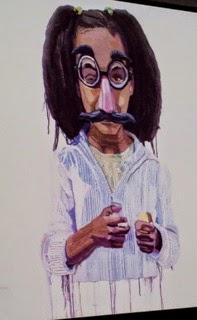
 Jo Hamilton, from Portland, Oregon via Glasgow, Scotland, fascinated a well-attended May 10 CQA meeting with insights into her process and resulting artwork.  Many in the audience had seen at least one of Jo’s pieces in person-- the memorable, more-than-life-size male nude in crochet form exhibited at the Bellevue Art Museum last year as part of High Fiber Diet.

Hamilton's piece shown in BAM's "High Fiber Diet" exhibit

Jo was always interested in color and pattern and went to art school wanting to do portraits and landscapes. Although she had learned to crochet from her grandmother (never advancing beyond the “granny square”), she resisted using textiles in her art for some time, pursuing painting instead.

After moving to Portland, Jo saw an exhibit at the Portland Craft Museum called “Not Your Grandmother’s Doily,” a collection of art made using craft techniques. This inspired her to turn a sketch of the Portland cityscape into an ambitious cityscape-crochet project that she worked on for two years, on and off.

Hamilton's sketch...
This 5 x 10-foot piece was very exploratory, and was originally square in format. It was originally pinned to the wall before she developed her process of mounting pieces to hardware cloth supports. (See Jo’s website, linked below, where you’ll find an image of this piece on the main page.) To enable shipping such a large piece, she makes the hardware cloth support system in panels that hinge together.

...turned into a large crocheted piece

One of Jo’s coworkers at a restaurant teased her about “crocheting all the way to Gresham,” a Portland suburb, and her response of “Shut up, or I’ll crochet you!” ended up inspiring her to attempt a crochet portrait.  She had not tried curves or facial features before, so she started by collecting photographic images of her coworkers, which led to a series of portraits approximately twice life size. 

One of Hamilton's fellow restaurant workers

Jo explained that the size of the portraits ends up being the result of how much detail you can get with a single stitch of crochet. Her pieces build out, generally starting from the eye. She uses all kinds of yarn—in the early years, almost all was from thrift stores, so most of it is budget yarn. The color and value are more important than the fiber content.

She ended up with a dozen portraits of her friends and colleagues from the restaurant staff, created in 2006-2008, and they were exhibited at the Stumptown Coffee Shop in 2009. 

Part of the display at Stumptown Coffee...


...that led to a further display in NY City


(A show in a NY coffee shop in 2010 ended up on television when HBO filmed an episode of Girls there.)  The coffee shop show led to her being featured on Oregon Art Beat, which led to her current show at the Schnitzer Museum in Eugene.

After the series featuring restaurant workers, Jo began a new series she called Mug Shots, based on photos of people arrested in Multnomah County. She looks at these as a way of humanizing people caught at a bad time in their lives—“They could be anyone,” she says.

One of Hamilton's "Mug Shots" pieces


Another of the "Mug Shots" series


By the time she did this series, she had developed techniques to make the work more detailed and painterly, mixing yarns as if they were paints to get intermediate colors. 

Jo has also made commissioned works. She did two dog portraits for her landlord (animals also fell into the “not again” category after that—challenging contours plus too much black and white!).  

 
Pet portraits are now a "not again" category
 

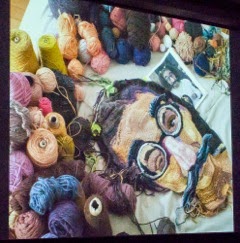
A newer series portrays only women, all in masks of some kind. 

Above and below: Some in the new "masks" series


 Jo brought some in-process photos of those to the meeting so we could see how the pieces develop.  
 
An "in process" work

 Another relatively recent development was a display in a fancy department store in Paris.  She made masks for mannequins and placed them against the Portland cityscape, with some additions she created to represent both Paris and London. The display was hanging for six months.

One of the pieces for a Paris department store

Hamilton placed some of her pieces in cityscapes

Jo’s latest work is still somewhat experimental. Based on a photo taken of an image on a television screen, it is pixellated enough that the image is obscured--quite a contrast from her previous work.  She considers this the first in a series of more abstract work that she’s interested in exploring.

One of the newer experimental pieces

Most of Jo’s work is characterized by the loose yarn ends that hang vertically from the edges of each piece. She simply got used to seeing them on the works in progress and ended up keeping them that way. The exception is a piece made from recycled plastic bags, where the “yarn” did not hang gracefully. (That material was also really hard on her hands, so fell into the “not again” category of artistic experiments.)

Loose yarns are characteristic of Hamilton's pieces (Front)


(Back of the same piece)

 
Jo likes working out of her home and she shared photos of her work space, which is the front room of her house. She spreads out her large pieces and work on a sheet or on the floor. To gain perspective, and some distance from the work, she stands on a chair and photographs it from above.

Hamilton's work space is also the front room of her home.

View of some of Hamilton's yarn "stash"

Because Jo’s pieces are large and not extremely portable, for the CQA program she ended by showing a few modular pieces of some of her work so the group could experience them in person. But if you are in Eugene between now and August 3, 2014, you can see some of her work at the Jordan Schnitzer Museum of Art.

Above and below: CQA members get to view some of Hamilton's modular pieces in person.


For more information and better images of Jo’s work, see her web site: http://www.johamiltonart.com/. To see a stop-animation video Jo made to illustrate her process, go here: http://vimeo.com/41159734.  It’s more than worth the 30 seconds it will take to view it (IF you can watch it just once!).

Saturday, April 19, 2014

Meet Deloss Webber: sculptor, basket-weaver, gardener...artist!

Deloss Webber addresses the April 12 CQA meeting
Kirkland, WA artist Deloss Webber says that "Most of my successes have been accidental," but it's taken him years of exploring methods, materials and techniques to arrive at those "happy accidents"! Webber's presentation at the April 12 meeting of Contemporary QuiltArt Association (CQA) demonstrated the wide variety of ways he combines nature and art.

Webber never had any art classes, but he grew up learning a craft that itself is something of an art form. His family operated a furniture business of restoring and repairing antiques, and Webber learned the skill of cane weaving from masters in the trade. It's small wonder, then, that some of his first original pieces involved weaving and chairs. "I came to realize that furniture is also an art form when there's collaboration between 'designer' and 'creator,'" he says.

One of Webber's first "woven chairs"
Woven on an old "butterfly chair" frame
From static furniture, he moved on to something that signaled inherent movement: a full-sized (11-12-ft) kayak, woven from ash splint, raffia and found objects! "I wanted to form a narrative of the traveler who used this type of piece," says Webber.

Full-sized kayak woven from ash splints, raffia and found objects

Wood is another natural material that Webber has used to great artistic advantage, and he's not above recycling pieces from broken fences and salvage yards. He created a "herd" of small, blocky, wooden horses from a salvaged deck; then taking the idea into a larger scale, he created horses that were covered in a "painted veneer" of 1/16"-thick pieces taken from discarded fence boards. Any paint that Webber uses (or adds to recycled materials) is bought at garage sales!

"Herd" of small horses from salvaged deck materials


Larger-scale horses, "smoothed" from original blocky design
Reclaimed fence boards with original paint
Horses "veneered" with thin pieces of reclaimed fencing
Closeup of mosaic "veneer" on red horse
Webber's installation of carved wooden balls
Material for this curved wood installation came from a downed fir tree nine feet in diameter.

 
Much of his subsequent work has combined woven materials with stones. Says Webber, "I may find a stone or object with appeal and then I figure out how to provoke a conversation. Or, alternatively, I have an idea and then wait for the right rock to appear."


Webber needs a jig, templates and a number of tools to work the stone.
Webber often dyes the fibers, using procion dyes.
This piece is about 30" high and weighs about 60 lbs. The stone is black granite; the white circles are abalone shell.

Some of the rocks he works with come from the several commercial stone yards in the area, but he also finds excellent candidates on his own large property east of Lake Washington. And such a large property provides Webber more than just raw materials: "Having the room to work has made a huge difference in my artistic progress," he says. The artist has made a few side trips into whimsy along that journey, including building a wonderful tree house on his land ("It's not a studio, but more of a place to think.") and several "mosaic" figures, created from broken bits of china, wood, stone and fibers, that resonate with viewers.

Webber's tree house "folly"
A whimsical portrait of broken china, pieces of wood, etc.
This pair, created of broken pieces of china, wood and found objects, always attracts interest.

Limestone is a frequently used material. Some pieces he has cut and shaped himself with diamond tools and salt processes, an example being rounded pieces where he's created line and movement from static forms in a Northwest palette and language.

White limestone, shaped by the artist
Black granite is another favorite material. One piece using this material, titled "Give and Take," closely resembles two wrecking balls...he distressed the stone so that the pieces "show their own history."

"Give and Take," distressed black limestone

Webber stresses that presentation of an art work is critical: "The job isn't over when you've created the piece...you need to extend the idea into the environment, as this gives a relevance to the body in space."

Webber spends time creating the proper presentation for each piece.

In 1998, Webber happened upon the Kagedo gallery, a private gallery then operating in Seattle. Intrigued by the Japanese style of wrapping and knotting fibers over rocks displayed by the artisans in the gallery, he began to try his hand at it with the gallery owners as mentors. It was a long, long process: "Their philosophy was that it takes 10 years to learn to split bamboo and cane, so my two to three years of struggle was nothing!" Finally, it was samples of Webber's work at this gallery that led, often in "accidental" ways, to exhibitions of his pieces across the US and in London and Paris.

Webber's "wrapped rocks" using traditional Japanese techniques
Webber says he has "about a two-hour attention span," so he's constantly switching from weaving to stone work and vice versa. Even then, he says, "I live in my studio so my work is always on my mind. I keep changing surfaces, sizes, materials and so on, so that  I am always exploring and challenging myself."

Basket woven around a rock "boat" containing small round rocks; driftwood handle.
Webber added pigment over the surface of the weaving to resemble medieval frescoes
The over-painting "adds more intrigue and story"

Even though Webber says it's about how he feels about a piece or installation that matters and not whether or not it sells, he admits that learning how to make art is "just the tip of the iceberg. Marketing your work to galleries is itself an art, and then there's the new avenue of social media..."

A trio representing different designs of weaving
The blue object in the basket is stone; the handle is driftwood.

Webber's works are in a number of private collections, and have been displayed across the US and Canada, and in the UK and Europe. For more information, see www.delrocks.com.