Sunday, February 21, 2016

Small things have great meaning for artist Amanda Devine

Seattle-area artist Amanda Devine at Feb. 13 CQA meeting
A chance viewing of a small urban scene outside a hospital room window led to years of visual explorations for Amanda Devine, an artist in the Puget Sound area. At CQA's February 13 meeting, Devine shared some of the results of this event as well as other aspects of her more than 40 years of artistic pursuits.
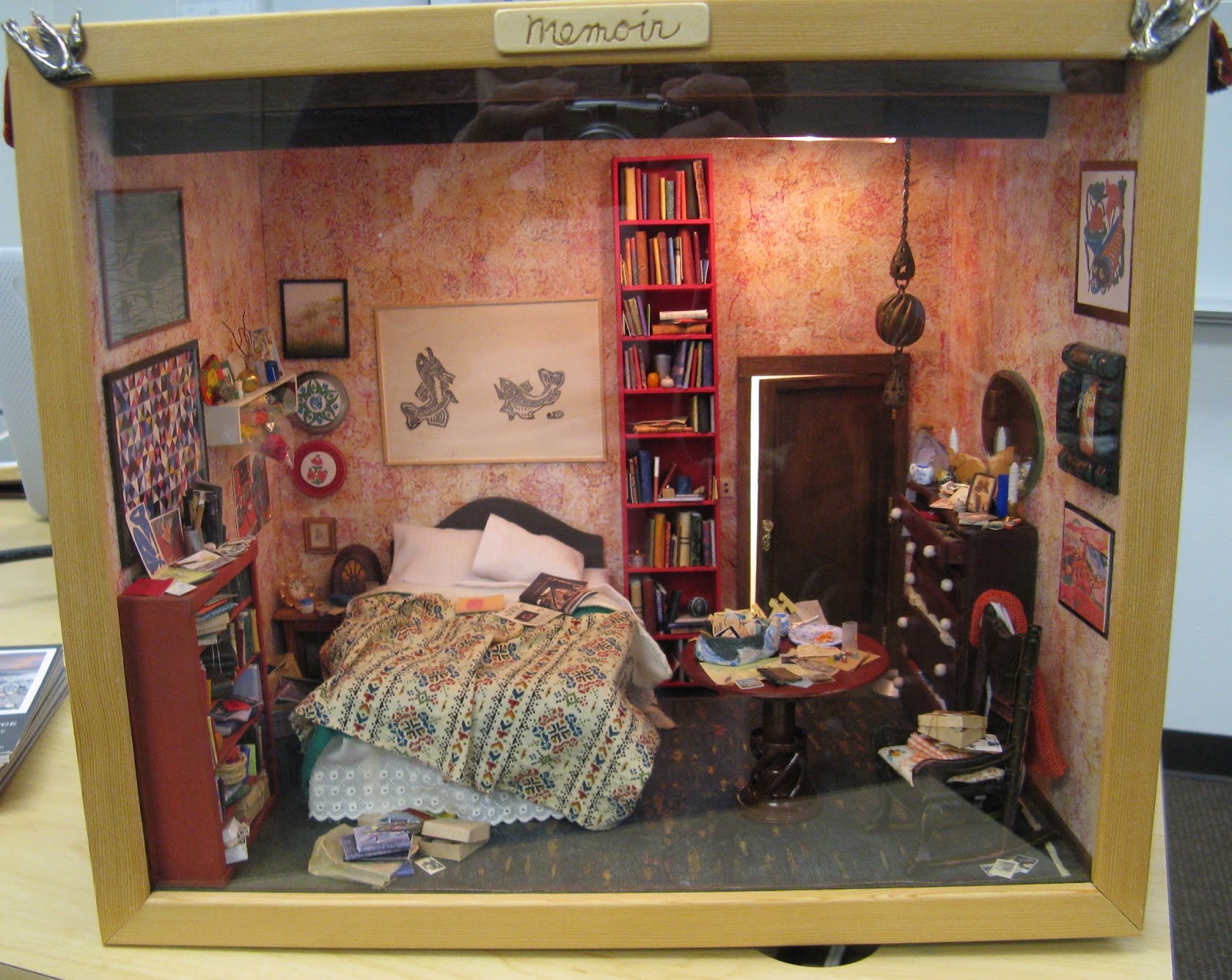
"Memoir," a shadow box created by Devine displaying miniatures of actual items she found while closing her aunt's house which had been her grandmother's house. (12"x15"x12")
Devine's "Echo." Packing material stuffed with found objects. (Mixed media/encaustic. 7"x7"x3")
One of Devine's mixed media pieces featuring various papers, photograph, buttons. (13"x9"x3") (Amanda Devine photo).

An early Devine photo where she manipulated a "regular" photo using a paper negative.

Devine was already involved in photography, and especially alternative photographic processes when, in 1977, she was "practically living" in a Los Angeles area hospital during her husband's  week-long recovery from surgery. Looking out of the room's window one day, Devine realized that an elderly woman she saw feeding birds in a nearby parking lot had been doing this same thing several days in a row--it was her routine.

One of Devine's first "Lavina" series photos. Lavina (dark figure in center, just below rear of first car) has just finished feeding the large cluster of birds, left.
Pushing a shopping cart, Lavina (upper right near white car) presents the figure that Devine used so extensively in her "Lavina's Song" series of pieces.
Devine had only a simple camera with her at the time, but began taking photos of the "bird woman" as she entered the area, fed the birds, then slowly moved out of the scene. Not long after, Devine came across an illustrated newspaper article about the woman and learned that her name was Lavina, and the woman was quoted as saying "The birds are always hungry." Even though her photos were snapped more than composed and the negatives were scratched, Devine ended up with a sequence of 40 photographs that provided a basis for a wide variety of expressions in her art, including the series titled "Lavina's Song."

The newspaper story that identified "the bird woman" and told her story. (Amanda Devine photo)
Using Kodalith thin paper for the high-contrast images it produced, Devine made up a set of 40 prints of her Lavina pictures and then began printing portions of them. As she worked, the birds began to look like musical notes, and Lavina's shape reminded her of calligraphic symbols; some she even made into rubber stamps ("rather clunky!"). Combining the elements in different ways led to the series of prints and mixed-media pieces that make up "Lavina's Song." (One part of the series is shown below, in Devine's photo.)

Devine combined a piece of one of her "Lavina" series photos with bird sketches in this mixed media piece. (Amanda Devine photo)
"I spent 30 years trying to tell the story," Devine said. "If the photos had been better quality, I might have quit with just one set of photos!" As it is, in 2002 the whole series of "Lavina" pieces were framed and displayed in hallways on the 7th floor of Seattle's Swedish Hospital.

In various moves, Devine downsized from her own darkroom to an early MacIntosh computer given to her by a friend. This opened  up a new world for her; she has subsequently kept upgrading to the newest Apple equipment. She gives great credit to the "genius bar" staff at the University Village  Apple store for guiding her along in her art. She digitized the original "Lavina" negatives after 30 years and, with this computer capability, turned them into a book.

One of Devine's "Convergence" series large-scale (14x34") images. (Amanda Devine photo)

Devine has more recently returned to her original photographic "roots" with a series titled "Convergence," comprising 18 large-scale photo images (14" x 34") that she prints herself "each in an edition of one." Most of the subjects in this series are of shorelines and water, as are the images in her "Exploration" series that feature closeups of beach elements in smaller scale. One of her very long pieces in the nature genre was displayed in her solo exhibition at the Commons Gallery in Sammamish City Hall.
An image from Devine's smaller-scale "Exploration" series. (Amanda Devine photo)

Devine has had pieces in an extensive list of exhibitions since the mid 1970s, including both her photography and mixed media. For more about Devine and images of her work, go to amandadevineartist.com.

Devine's daughter took this photo of Amanda being swarmed by birds at the shoreline..."the birds are always hungry" is a fitting title!

Sunday, January 31, 2016

Helen Remick's unusual materials "stitched" together to be shown at National Quilt Museum

Remick's "What I Want to Remember" (Mark Frey photo)
There's big news from CQA member Helen Remick! Her latest work, "What I want to Remember," is one of 25 quilts selected for the National Quilt Museum’s "The Gala of the Unexpected." It will be on display at the museum from April 14 to July 12 and will then travel through the end of 2017.

The quilt top is made of 35mm film negatives and overhead projector sheets printed with pictures from the negatives and other sources. Helen says of the quilt: "As my dear mother-in-law slipped into dementia, she and I repeated two lists that were important to her: the names of family members, and the places she had lived. As I finished this quilt I realized that I had created my own list. The photographs are of the people I love and the places I have been."
Detail of "What I Want to Remember" (Mark Frey photo)
Asked about how she constructed this piece when putting together such unusual materials, Helen said, "I saw potential in the 35 mm film precisely because the holes for stitching were already there, and were even.  I have a Cricut paper cutter, one of the early versions, that can be programmed to do odd shapes.  I drew a pattern for the printed areas, printed the overheads, and then cut the shapes, including the holes to match the film.  The only thing I had to punch was the diagonals on each film strip.  A nasty job, but a limited one.  Then it was easy to sew together with yarn.  The top is fastened, not quilted, to the two other layers: tulle and felt."

For more about Helen and images of her other pieces, go to www.helenremick.com

Saturday, January 23, 2016

CQA to host a one-day symposium April 16

Symposium speakers (from top): Dr. Sandra Sider, curator, Texas Quilt Museum; Cathy Izzo, Art Quilt Gallery, New York City; Kris Sazaki, president and board member, Studio Art Quilt Associates (SAQA)
Calling all art quilters!

Enjoy a day of gathering, inspiration and learning! CQA's upcoming Quilt Art Symposium promises to shine a light on the future of Quilt Art with three leading speakers--Dr. Sandra Sider, curator of the Texas Quilt Museum; Cathy Izzo of the Art Quilt Gallery, New York City; and Kris Sazaki, president of SAQA.

The full day includes a luncheon, a tour of the CQA exhibit "Cutting Edge," and an opening party!

**Saturday, April 16, 2016
**Washington State History Museum
**Tacoma WA

Hotel details, ticket info and other information on the event are now available at: www.quiltartsym.com

Thursday, January 14, 2016

CQA members get messy at annual "Play Day"

CQA artists at play, January 9, at Bellevue Arts Museum
Splashing paint around was definitely on the agenda as members of CQA got together January 9 at Bellevue Arts Museum for the group's annual "Play Day" to try out a variety of surface design techniques. Many thanks to the Program Committee for the arrangements (Helen Johnston, Nicole McHale) and especially to the instructors/demonstrators for being so generous with their materials and information: silk screening (Colleen Wise), stamping (Margaret Liston), "gelli printing" (Ginnie Hebert), and marbling (Helen Johnston). And thanks to BAM for hosting us again for this, our third year of play days. A good time was had by all! Here's a look at the day's activities, in photos.

STAMPING WITH TEXTILE PAINTS
Some stamps required careful painting. (That's instructor Margaret Liston at left.)
Other stamps could be painted more casually.
Stamping the same design in different colors makes for an interesting result.

Overlaying a different stamp design in a third color adds even more interest.

SILK SCREENING
Instructor Colleen Wise (green shirt) imparts the basics of silk screening on fabric.
Leaves proved to be a popular design for silk screening.
This silk screen for a pattern features both orange and purple paint....
...for a very  interesting two-color result.
Silk screening patterns, rather than objects, was also popular...
...as in this nice contrasty result.

MARBLING
In marbling, drops of paint on a jelly-like surface can be swirled for free-form patterns...
...with this attractive result.
This multicolor marble paint pattern will have spectacular results.
An interesting swirl pattern in neutrals. The blue and yellow "masks" in the background have holes that confine the paints and provide interesting patterns [see photo below].
Very unusual results were achieved with the use of a mask with many open "holes."
A bright marbled design.
Marbled pieces: The one at the left used the "mask" with holes; the one at the right was free-form.

"GELLI PRINTING"
Monoprints, many with textures from pattern forms (right foreground) were achieved from fabric paints applied to "gelli" forms such as the circle, right background.
Daubs of paint were applied to the gelli forms (this one a rectangle), then spread out with a brayer, so that fabric could be placed on the paint to achieve the desired monoprint design.
The paint was given this design on the round gelli plate...
...fabric was then placed over the paint and firmly rubbed....
...so that the painted design is offset onto the fabric.
Twin designs from the gelli plate were achieved directly (left) and with a stencil (right).
...AND SOME MORE FINISHED PRODUCTS:
Products achieved through silk screening and gelli printing, above and below.


Tuesday, December 15, 2015

CQA enjoys visual and tactile treats by Larkin Van Horn

Mixed media artist Larkin Van Horn makes a point at the Dec. 12 CQA meeting. (Sue Smith photo)
"I like creating something hard on something soft...and something shiny on something matte." That's one working premise for Larkin Van Horn, a prolific Whidbey Island mixed-media artist and teacher who shared her work and her thoughts with CQA members at the group's December 12 meeting.

Van Horn came from a family of embroiderers--"no quilters!"--and that was her medium for a number of years. Then in 1972 she started beading. Her first project? Her own wedding dress! Apparently the experience was a bit much, as it was another 15 years before she picked up her beading materials again. Even then it was a bit of serendipity: She was working part time at a cross-stitch shop, making samples, when she decided to gussy up the pieces with some beads from a bead shop that happened to be right next door. "Pretty soon I was doing more beading and less stitching!" she laughed.
"Pods II." The quilting design was inspired by one of Van Horn's half-waking, later-puzzling, thoughts scribbled down in the early morning: "What about a stick with a hole in it?"
"Crucible." Small pieces fused into place; beaded center.

At some point the idea  of making quilts intrigued her, and Van Horn signed up for her first class in this art, only to find she wasn't good at following others' directions. She made her own way into the art-quilt world and also has made a number of quilts that, like her more current technique (collage), often serve more as the base for beading and threadwork than as stand-alone quilts. "My pieces are small," she added, "because the beading is so intensely done."

She uses her own hand-dyed cotton and silk fabrics for the backgrounds on pieces she creates for exhibitions, but her class samples are done on commercial batik backgrounds: "The students like to work on something that's readily available to them."
"Hold Fast Your Heart." (Sue Smith photo) [The small squares at top of photo are part of the "My 60th Year" project; below]
Detail of "Hold Fast Your Heart." Van Horn often uses porcelain or ceramic faces as central points in her work. (Sue Smith photo)

"Most of what I do now is fused fabric collage with 'stuff' on it," explained Van Horn. The "stuff" can include yarns, various strings and thread creations, porcelain and ceramic faces, found objects and, of course, beads, lots and lots of beads...and sometimes beads on top of sequins for extra sparkle and texture.

One of the most extensive exhibits of Van Horn's work was titled "Night Thoughts," at the Latimer Quilt and Textile Center in Tillamook, OR, where Van Horn has both exhibited and curated a number of exhibits. This show, which also traveled to the La Conner Quilt & Textile Museum in La Conner, WA. was three years in the making. "I had to create about 100 new pieces for the exhibit," said Van Horn, adding "About 80 pieces would be hung on walls, and another 20 would go into display cases. The Latimer Center was able to show all the pieces; La Conner hung all the wall pieces but couldn't show the 3D work." She added that the theme or title of the exhibit was "the first thing that came out of my mouth when Latimer asked what the show would be called. I had no idea what it meant, but there it was!"
"The Soul's Winter." Part of the Shattered Circles series.
Detail of "The Soul's Winter." (Sue Smith photo)

When listeners asked Van Horn about threads for beading, she noted that beads are sharp, so you can't use rayon, cotton, metallic or any of the usual sewing thread without having the threads shredded or cut by the beads over time. She uses nylon beading thread, doubled--"If one part starts to shred, you have a chance to replace or fix it before the whole thing breaks," she explained. Another choice would be "Fireline," a synthetic fishing line purchased from outdoor stores. She added one warning: "Fireline can't be ironed...it'll melt!" The fusible materials she uses include both Misty Fuse and Wonder Under,  depending  on the type  of project.

Someone asked about handling bugle beads, notorious for having sharp ends. Van Horn told of a head-scratching experience she had once at a small beading session at a conference in Santa Fe. When the subject of bugle beads came up, one beader said "Oh, I paint the ends with colorless nail polish." The next beader said, "If you use colored nail polish, you get a 2-tone effect." A third beader said, "I use acrylic paint!" The final beader opined, "I have the best method. String them from a coat hanger and spray with an acrylic spray, then use a toothpick to spread the beads apart." At this point, Van Horn interjected: "Why not just put a seed bead between each bugle bead?" Came this rejoinder from the table: "What a waste of beads!"
"Firestorm II"

Many of Van Horn's pieces fit into specific series she's been developing over the years, such as Shattered Circles; Labyrinths; Trees; Angels, Goddesses and Mermaids; Dolls; Gaudi Windows, and Vessels, Shrines and Reliquaries.

In the "Shattered Circles" pieces, she takes a circle of fabric and, either freehand or by following a hand-drawn sketch, cuts the circle into a number of pieces. She then "explodes" the pieces outward from the center to create what is often an extremely complex design that sometimes completely disguises its circular origin. "My rule for myself in these pieces is 'Use every piece'!" Van Horn said.
"Emerging III," part of the Shattered Circles series. Van Horn follows the rule of using every piece of the cut-up circle...but there's no rule against adding something else!

"La Deluge," part of the Shattered Circles series--the orange-red "fronds."


She differentiated a labyrinth--"It leads you into the center and back out again"--from a maze--"It's created to confuse"--and described how she does machine quilting on labyrinthine pieces where the "path" is often a thick cord that would deflect the "foot" of a sewing machine.
"Celtic Spiral VII," part of the Labyrinth series.

"Labyrinth II." Van Horn uses a positioning drawing for the future labyrinth line so that all machine quilting can be done before the thick corded line is applied.

A trip to Barcelona led to her five-piece series of "Gaudi Windows," where her works mimic the shapes but not the colors of the windows in some of Antoni  Gaudi's buildings. For the "Angels, Goddesses...." series, Van Horn, who described herself as "a Lutheran Buddhist Pagan," said she did only one angel but "a whole lot of goddesses!" Her intensely beaded dolls are "meant to be like a 'talking stick'--the one holding the stick is the one who gets to talk--so that you tell your story or your doll's story while you're holding her."
"Bright Gaudi Day," part of a series of five pieces inspired by the architecture of Antoni Gaudi in Barcelona.
"Pele," one of Van Horn's series of beaded dolls ("and yes, I give them all boobs!")
"Dancing in the Moonlight" from the Goddesses series. The "moon" is another shattered circle.

"Deep Sea Troika" in the Goddesses series.

The "Vessels, Shrines..." series is largely 3D work, for which Van Horn said she buys the stiffener Timtex in huge rolls. This series includes a number of boxes where the sides are quilted and beaded with the edges finished with a machine satin stitch, then sewn into the final box shape by hand. She defined this series by saying "A vessel is something that holds something else--a leaf that holds a drop of water is a vessel. A shrine can be for anything that anyone holds sacred, and a reliquary holds any object that is considered sacred."
"Starflower Box," in the Vessels series. The edges are finished in machine satin stitch, then the pieces are sewn together by hand.
"Tree House I" in the Vessels series..."A vessel is something that holds something else..."

On her 59th birthday, Van Horn embarked on a year-long project that would culminate on her 60th birthday--each month, she would create a small square of fabric, quilted and beaded in whatever design struck her fancy on that month. Each was titled, signed and dated on the reverse side as part of a permanent record of what is a milestone for so many of us. And of course she created a special box to hold these little treasures.
"My 60th Year." Van Horn created a heavily beaded little square each month between her 59th and 60th birthdays, plus a beaded box to hold them.

Van Horn's works, which include some exquisite pieces of beaded jewelry, have been in exhibits throughout the country and are found in many collections. To see images of her various pieces and series, go to: http://www.LarkinArt.com.

(All photos by G. Armour Van Horn unless otherwise credited.)